There’s a particular kind of restlessness that eventually becomes impossible to ignore — the sense that you’re playing a smaller version of yourself. For Tino, vocalist, composer and founder of Invoker, that restlessness had been building for years. It finally broke open with the band’s new music, and the reckoning that produced it is as much a story about identity as the record itself.
Invoker had built a name within extreme metal doing what extreme metal traditionally does well: speed, aggression, precision. It worked. But somewhere along the way, Tino found himself increasingly certain that the band was capable of more than the genre’s familiar shapes allowed — and that staying inside those shapes was starting to feel less like discipline and more like avoidance. «At some point you have to stop refining the thing you already know how to do and start doing the thing you’re actually here to do,» is the sentiment that, according to those close to the project, has driven every decision since.
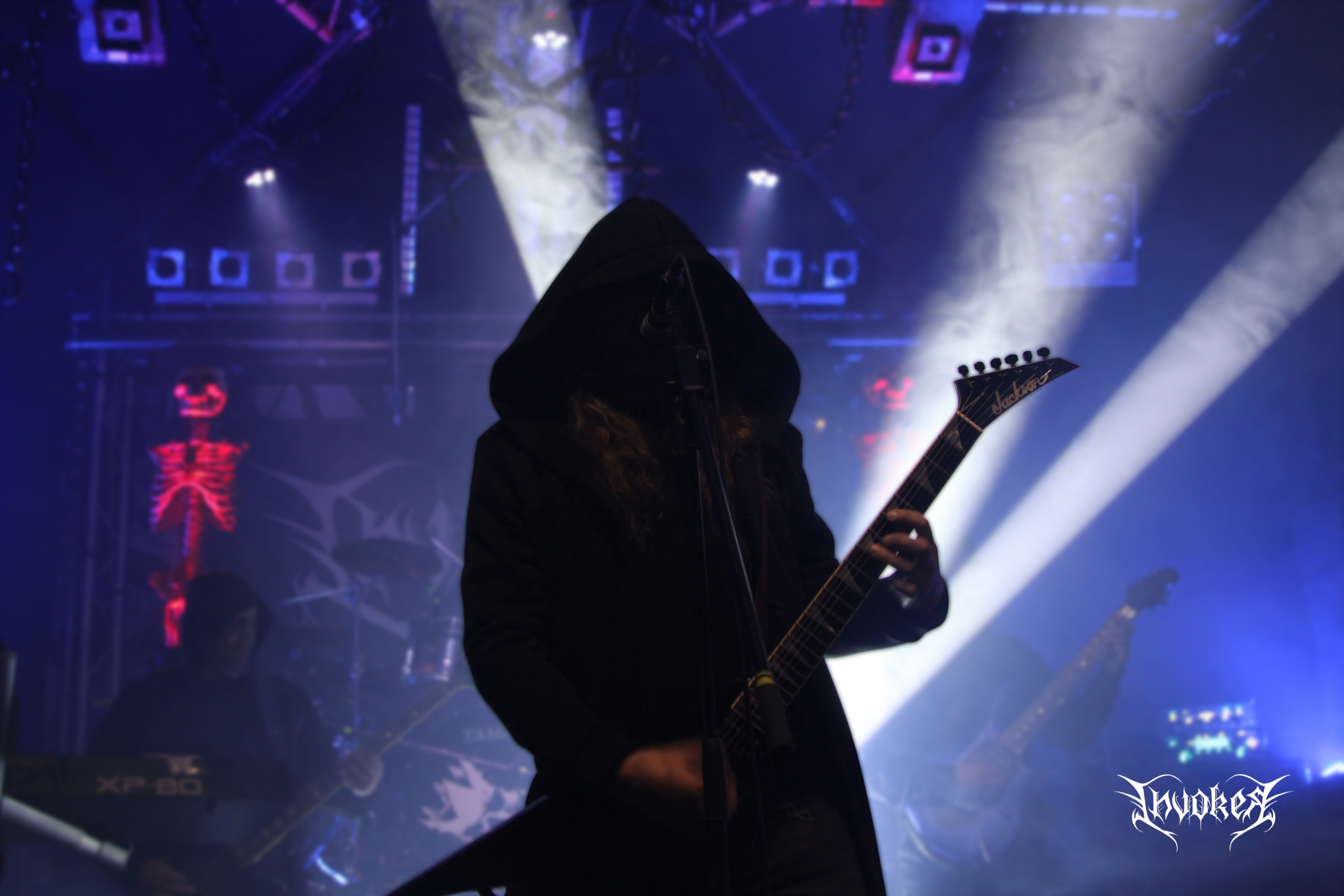
That decision didn’t stay abstract. It reshaped the music, the visual identity, and the way the band presents itself on stage — a full transformation rather than a stylistic tweak. The new material is the first evidence of it, and it doesn’t sound like a band easing into change. It sounds like a band that finally stopped negotiating with itself.
A SINGEL UNBROKEN STORY
The new music was never conceived as a standalone release. Together with a forthcoming full-length album, it forms one continuous conceptual work — an immersive meditation on the human condition itself: birth, growth, aging, decline, and the fragile, unreliable nature of memory and identity. The narrative draws directly from the realities of dementia and the passage of time, structured through distinct stages that mirror the arc of a human life. Personal experience becomes a haunting sonic landscape, rather than a lyric sheet with a message attached to it.
Crucially, the record is built to be heard as one uninterrupted piece. Individual songs don’t end so much as dissolve into each other — atmospheric transitions constructed from tinnitus-like frequencies, layered noise, distant thunder, and ambient textures blur the boundaries between tracks entirely. The effect is deliberate: no clean exits, no chance to step outside the narrative and catch your breath. Every sound is in service of the story, and that story is built on a sense of inevitability — moments of clarity that gradually give way to uncertainty and dark.
FURTHER OUT THAN EVER BEFORE
Musically, this is Invoker’s most exposed work to date. The band remains rooted in extreme metal, but Tino pushes into territory the project has never fully claimed before — atmospheric, experimental, avant-garde. Expansive post-black metal influences intertwine with dissonant textures, cinematic soundscapes, and arrangements that refuse to resolve the way genre convention expects them to. It’s a record that trades some of the immediacy of straightforward aggression for something slower to unfold and harder to shake — emotionally direct in a way that pure intensity alone can’t achieve.
That trade-off is really the point. This new face of Invoker isn’t a departure for its own sake; it’s what happens when a songwriter finally writes toward the thing he’s been circling for years instead of around it. The result is both more vulnerable and more ambitious than anything Invoker has released before — a band leaning into discomfort because the alternative, staying comfortable, had stopped being honest.
A FOUNDATION NOT A PEAK
The new material is explicitly positioned as a beginning rather than a destination. It lays the groundwork for the full-length album to follow — one promised to be even more immersive, even more boundary-pushing. But the significance of the music doesn’t depend on what comes next. It marks the moment Tino, and by extension the band built around his vision, stopped asking permission to become what they were always capable of being.
Extreme metal has never lacked technical bands, or heavy bands, or atmospheric bands. What it has always lacked is enough bands willing to risk sounding uncertain, unresolved, human. With new the music and concept, Invoker steps into that risk fully — darker, more atmospheric, more experimental, and unmistakably more themselves. Whatever comes with the full-length, this is the sound of a band that finally stopped waiting for the right time to become what they were meant to be.